There’s More to Flight Instructing Than Simply Logging Hours

There’s More to Flight Instructing Than Simply Logging Hours
No individual can enhance aviation safety as much as a flight instructor. Here’s why I’ve held my flight instructor certificate for more than 50 years.
After earning my private pilot certificate in the early 1970s, I couldn’t think of anything more exciting than sharing my love of flying airplanes with other people smitten by the bug. I’ve always thought of myself as a teacher in one way or another having taught air traffic controller trainees, college students as an adjunct communications instructor at Northwestern University and of course pilots of all categories. For me at least, building time was pretty low on my totem pole.
Earning my instructor rating was work for me as a young pilot. Not only did I have to prove I understood enough aerodynamics, regulations, weather, risk management, safety and other important pilot topics, but I had to prove I could explain them to someone who knew nothing about aviation before we met. Naturally, I also had to prove I could diagnose any learning problems students might encounter along the way.
There was some fun mixed in though, like learning to fly from the right seat or sometimes the back seat. I never realized in the 400 hours or so I’d logged to that point in my CFI training how many of the flying cues I took for granted were based on my sight picture from the left seat. But it eventually all became second nature.
My real motivation though was proving I could do it – Fly I mean – a task that had once looked impossible after spending my early flight hours with a terrible instructor. After logging just 16.6 hours of flight time in an orange, fabric covered, Aeronca 7FC Tri-Champ, my instructor had me convinced I lacked the talent to ever learn to fly.
The University of Illinois
At 17, dream-crushing experiences like this were overwhelming. I never told anyone because I lacked the courage at that point in my life to push back against an instructor who believed effective teaching included as much yelling and abuse as he could muster.
That said, I’s like to share some of what I’ve learned over the years about the value of a good flight instructor and how to know when it’s time for you, or someone you know, to stop wasting their time and money and ditch a jerk.
Back in 1966 I was a freshman in the professional pilot program at the University of Illinois’ Institute of Aviation in Champaign (KCMI). On the first day of my private pilot class, I was randomly paired with a young flight instructor, I’ll call Dan. He’d worked his way through the professional pilot program himself and stayed on as an instructor to build time. At 17, I had no idea what to expect from the process of learning to fly and Dan didn’t offer much guidance.
The weather in Central Illinois was bad during those first few weeks of my freshman year, so Dan and I began with some ground school and simulator sessions. In 1966, that simulator was called a Link trainer, a bare bones box of an airplane that included an

instrument panel with a few round gauges, a control stick and a unique canopy cover that kept me from seeing anything outside the pretend cockpit. It also moved some to add realism. It was a bit like riding a roller coaster in the dark.
Finally, the weather cleared and we found ourselves on the hangar ramp one morning pre-flighting the Champ. Those first few flights were nothing short of glorious.
In those days the university’s aviation program kept the tower guys at Champaign pretty busy too when a herd of Champs all blasted off within a few minutes of one another. One of Champaign’s main runways – 22 – was paralleled by two sod runways, Sod Left & Sod Right so I quickly acclimated to landing on the grass and the asphalt.
After what seemed like just a few hours of air work in the practice area, we launched into landings. I’m sure we did takeoffs too, but the landings imprinted on me because that’s where everything seemed to come unglued.
From my perspective six decades later, I can tell you Dan was clearly an impatient, nervous instructor despite the friendly, down home personality he tried hard to convey. I later learned jittery pilots are usually the product of another edgy instructor or a knowledge deficit about teaching, or both.
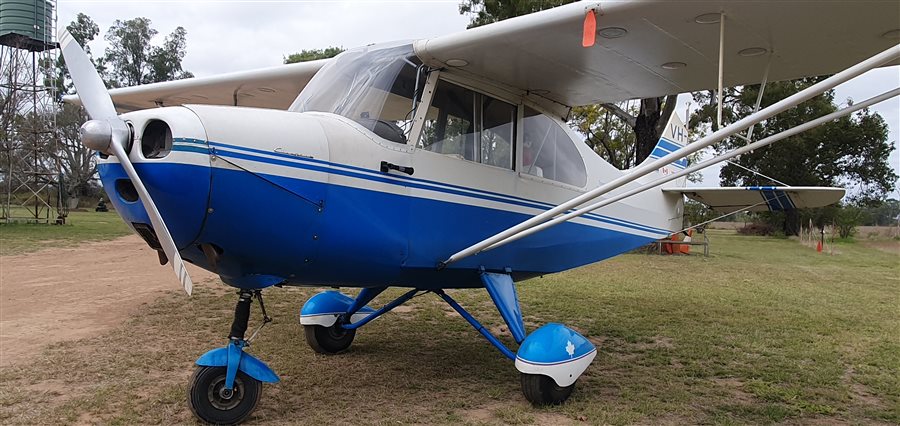
Like many airplanes of its time, the Champ was designed with one seat in front for the student and the back for the instructor. We used headphones to communicate because of the noise. The radios were as basic as they came in those days with a crystal controlled transmitter and a tunable receiver
I guess I wasn’t the fastest learner because Dan’s impatience with my progress appeared early on and seemed to grow with each lesson. If I didn’t maneuver the airplane as expected, he’d shake the back of my seat to reinforce his point. Over the few months we flew together I came to believe that shaking or kicking the seat was a regular part of flight instruction. I remember Dan added a particularly scolding third-person comment in my logbook one day that said, “Student not responding to my communications.”
“What are you doing?” he might yell before he whacked the back of my seat as proof of my screw ups. I can’t remember exactly what mistake I made during one session, but one morning he kneed the back of the seat hard enough to knock off my headphones. As the weeks passed, no one in the flight department ever asked me about my progress, so I remained silent about everything. Much to my surprise, Dan signed me off to solo in the pattern in late October.
But that ego boost was short lived. During landing practice in early November Dan was nervous and decided to talk me down final, “don’t get too fast … not that slow … “then … WHAM, we hit the runway, luckily on just the mains … but hard enough that my headphones fell off again.
 Dan was whacking the back of my seat yelling, “Why didn’t you flare?” As I was slowing the airplane he was still yelling … “Why didn’t you flare?” After I turned off near the end, I just sat there a minute before I finally mustered some courage, “What part was the flare again?” I don’t remember much after that. But paging through my logbook later, I stumbled upon a comment about my landings I never forgot. “Terrible” was all Dan wrote. I knew I didn’t have what it took to fly airplanes.
I don’t remember if we had a debrief that day, but I just quietly left the airport on the shuttle bus back to the main campus. I attended some other class that afternoon, but I have no idea what it was. My head was somewhere else.
My feelings weren’t just hurt, I was crushed. I’d been a lousy student in high school and apparently college wasn’t shaping up any better. Strangely, I don’t remember anyone from the flight program asking me why when I was thinking of dropping out. Even if they had, I doubt I would have commented on Dan’s teaching style. It was all my fault anyway. The next day I did the only thing I could. I packed my suitcase and left the university and the flight program knowing I would never go back.
I didn’t fly in a GA airplane for another five years.
All About Ray
Jumping ahead now, it was the spring of 1971. I was a Staff Sergeant in the Air Force stationed at Bergstrom AFB in Austin, Texas. I’d joined the Air Force to get away from home and from people constantly asking me what happened to my dream of becoming a pilot.
One sunny spring Texas afternoon, I was sitting in the bleachers outside the base’s aero club. I’d often walk over after work at the control tower to watch the airplanes taxi in and out of the club as well as watch the B-52s practicing landing and takeoffs trailing thick black smoke for miles
I guess I was there often enough that one day one of the club’s instructors waved to me as he was walking out to a Cherokee with his student. “It’s a great day to fly man. Why are you just sitting in the stands?” I shrugged my shoulders feigning confusion, but I waved back.
A few days later, I watched the same airplane taxi into the ramp. The same guy climbed out with a student and waved again. I waved back.
Maybe 15 or 20 minutes later that instructor walked out of the aero club’s old gray hangar toward me in the bleachers. and stuck out his hand. “Hi. I’m Ray,” he said. “I’ve seen you out here a couple of times. Are you learning to fly?” I kind of choked a little at the question and just shook my head. “Nah. I can’t really learn to fly,” I told him.
He just stared at me for a minute and shook his head a bit. “Why not?” I just sat there unsure of what to say. He waited for a minute and then looked me in the eye. “You’d really like to learn to fly, wouldn’t you?” I took a couple of deep breathes and spit it out … “Yeah. I really would.”
He motioned me to follow him back into the flying club office. Ray spent the next 45 minutes listening to me tell stories about the debacle that was my 16.6 hours of flight training. He asked if I wanted to book a lesson for the next day. I did.
I restarted my flying lessons and the next 50 years became my aviation history.
I didn’t finish my private at the aero club because I was soon to be discharged from the Air Force. But I did earn it in Chicago a few months after leaving the service all because Ray’s teaching style was so radically different from Dan’s.
Thanks Ray. If you hadn’t popped into my life when you did, I know my life would have turned out much differently although my time at U of I taught me more than I realized. Although I searched for him many times over the years, I never connected with Ray again.
An Instructor's Responsibilities
Flight instructors possess a powerful opportunity to make a tangible difference in someone’s life, very possibly the rest of their life. Whatever a student pilot learns – good or bad – they learn from us. The habits we teach them, not only how they fly but also how they think about flying, will stick with them long after their flying lessons are over too.
As an instructor years later, my philosophy was simple. That man or woman in the left seat with me now wouldn’t always be my student. I had a moral responsibility to them and the industry to help them become the best and safest pilot possible.
Some instructors today seem to believe their job is to log as many hours as they can. Now there’s nothing inherently wrong with that. But instructors also need to remember that learning to fly is a business and students are customers. Those students deserve a solid return on the time and money they invest with us.
An instructor sitting in the right seat whose only goal is building time might keep their job, but they don’t deliver on the unwritten promise between a student and the flight school. In addition to getting a student through their checkride that promise says that when we release a newly licensed pilot into the national airspace system, that person is competent and safe. Through solid scenario training, that new pilot should have mastered the necessary subjects like aerodynamics, weather, risk management and a dozen others. But the instructor’s job is to also convince that new pilot that they now understand only the basics of flying.
That’s why they refer to a private pilot certificate as a license to learn.
They should know that one day – maybe soon – they may need to draw on that aviation education and some of their own common sense to synthesize the answer to an airborne problem their instructor never specifically mentioned. It’s also our job to ensure no student ever becomes an accident statistic.
If you’re an instructor and you aren’t thinking about these incredible responsibilities in addition to logging time, then please do your students, your flight school and the aviation industry a big favor. Please do become a professional pilot. We can never have too many.
But to build time, go tow banners or ferry airplanes or carry sky divers .... But please don’t pretend to teach others how to fly.
If you’re student and encounter an instructor like Dan, don’t take their abuse. Tell the chief flight instructor you deserve someone who really wants to teach.
I’m Rob Mark
ATC: 45 Years After the PATCO Strike