ATC: 45 Years After the PATCO Strike
Welcome to another episode of Stories about Flying
I’m Rob Mark
Air Traffic Control 45-Years After the PATCO Strike
Giving credit where it’s due, Sean Duffy’s leadership of the Department of Transportation, over the past 18 months, has led to more ATC hardware upgrades than anyone else I can remember. Duffy and the President last year pushed Congress, for $12.5 Billion, to begin replacing landline wiring, radar systems and communications radios. The Brand New ATC System (BNATCS) as the White House calls it, isn’t finished just yet, but it seems to be on its way, assuming of course, that Congress delivers the additional $17 Billion, Duffy says is needed to finish the job.
But there’s more to repairing the nation’s ATC system than just replacing aging hardware. The FAA employs more than 13,000 air traffic controllers, who provide the necessary human safety link, between the technologies, and the thousands of airplanes, that transit the National Airspace System (NAS) every day.
The last discussion I recall about the people part of the BNATCS, was during the 43-day shutdown of the federal government last year, when headlines focused on the need for controllers to remain at their jobs, even though they were not being paid, for their 10-hour days and six-day per week shifts. Just one more of the FAA’s management missteps over the years.
__________________________
Sunrise in Chicago on the morning of August 3rd 1981, was scheduled for 5:45 a.m. It was a Monday, and the weather forecast called for much the same as the night before, light drizzle, falling from low clouds hanging beneath a dark gray sky. Adding to the drudgery of a typical Monday morning back-to-work commute, many of the downtown buildings and streets, were shrouded in fog.
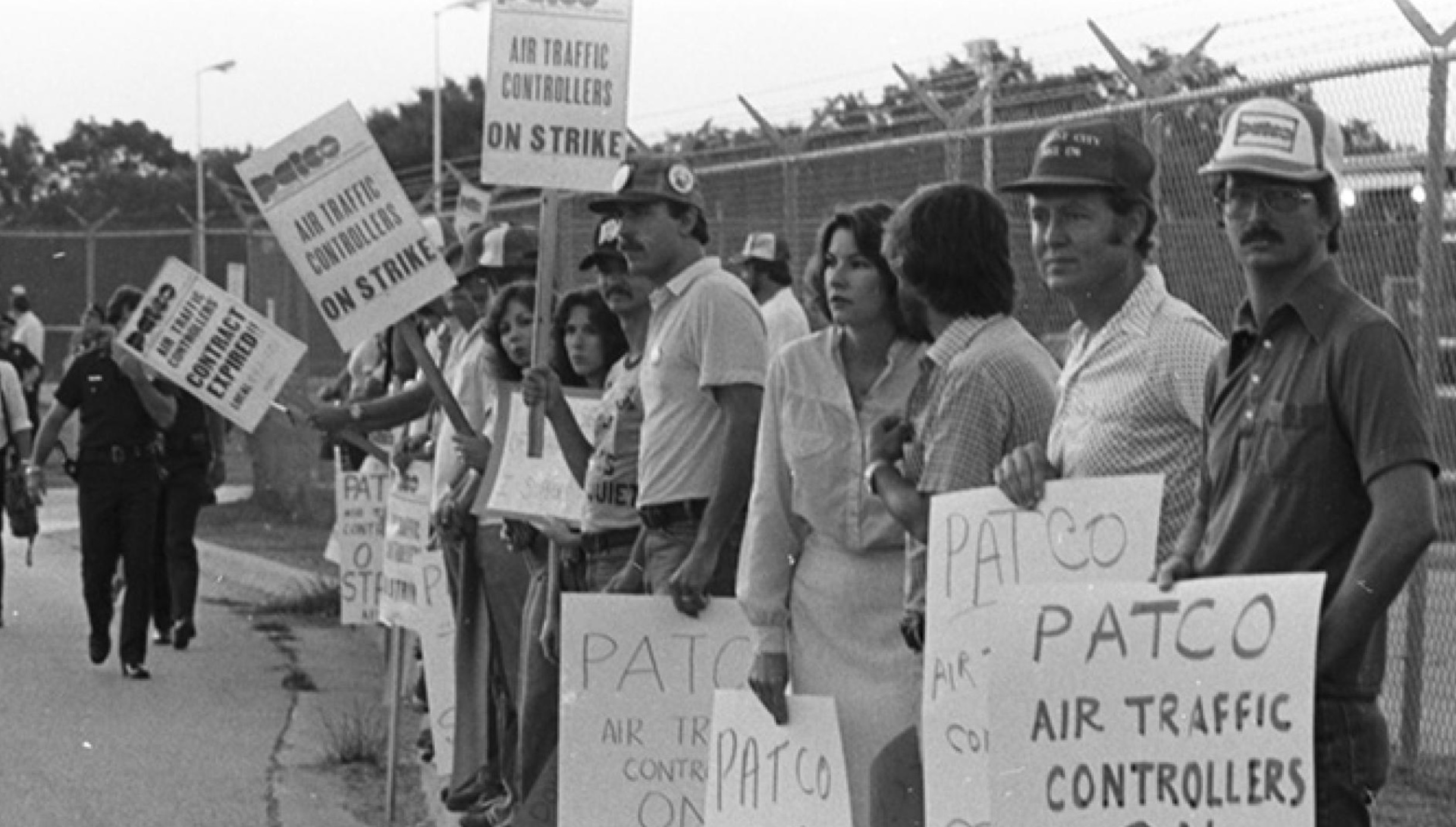
Fifteen miles northwest of Chicago’s Loop, however, the political winds were blowing with near hurricane force, at O’Hare International airport, as dozens of members of the Professional Air Traffic Controllers Organization (PATCO), carrying pickets signs, protested the FAA’s latest contract offer. Similar picket lines were also up at other ATC facilities across the US, in the first ever labor strike against the FAA.
Having spent many years as a controller around Chicagoland, some of the picketers were my friends.
On August 3rd, the FAA employed approximately 16,000 air traffic controllers. Eventually, more than 13,000 controllers joined PATCO’s picket lines, halting half the nation’s air traffic. That was 45 years ago this week.
PATCO's original demands called for a $10,000 across the board pay increase, a four-day work week, increased pension and disability benefits, and cost-of-living adjustments. Whether these demands were exorbitant, really depended upon your perspective.
On the morning of August 3, 1981, President Ronald Reagan informed the American public about the potential for disruptions in the air travel industry while also issuing an ominous warning to the picketers.
"This morning at 7:00 a.m. the union representing those who man America's air traffic control facilities called a strike. This was the culmination of seven months of negotiations between the Federal Aviation Administration and the union. At one point in these negotiations, agreement was reached and signed by both sides, granting a $40 million increase in salaries and benefits. This is twice what other government employees can expect. It was granted in recognition of the difficulties inherent in the work these people perform.
Now, however, the union demands are 17 times what had been agreed to, 681 million dollars. This would impose a tax burden on their fellow citizens, which is unacceptable. I would like to thank the supervisors and controllers who are on the job today, helping to get the nation's air system operating safely. In the New York area, for example, four supervisors were scheduled to report for work, and 17 additionally volunteered. At National Airport, a traffic controller told a news person he had resigned from the union, and reported to work because, quote, how can I ask my kids to obey the law if I don't, this is a great tribute to America. Let me make one thing plain: I respect the right of workers in the private sector to strike. Indeed, as president of my own union, I led the first strike ever called by that union. I guess I'm maybe the first one to ever hold this office who is a lifetime member of an AF of L C I O union, but we cannot compare labor-management relations in the private sector with government.
Government cannot close down the assembly line; it has to provide without interruption the protective services which are government's reason for being. It was in recognition of this that the Congress passed a law forbidding strikes by government employees against the public safety. That I must tell those who failed to report for duty this morning, they are in violation of the law, and if they do not report for work within 48 hours, they have forfeited their jobs and will be terminated."
___________________________________
Honestly, I thought most of my friends, were making a huge mistake, walking the picket lines that morning, but very few wanted to hear my two cents. They were still angry about an editorial I’d written for the Chicago Tribune a week earlier, calling attention to the darker side of the strike, the potential destruction of PATCO itself.
In that piece, I said, “If the union does strike and win, it would deal a crippling blow to the Reagan administration, and its control of its own employees. Other agencies would soon demand, a package similar to what PATCO won for its members, essentially the freedom to bargain for whatever they wanted, by whatever means they chose.”
J. Lynn Helms was the new FAA Administrator in 1981. Helms, a Marine Corp officer and the former CEO of Piper Aircraft, moved aircraft manufacturing from Lock Haven, PA to Vero Beach, Florida rather than give in to the demands of a union at Piper.
With that kind of management working at 800 Independence Ave., I knew the administration had a plan in the wings, to cope with a walkout, a plan that, “would use supervisors and military controllers, to supplement missing controllers. If air traffic flows after the strike, even for just a week, I said, the government will have won and controllers will begin trickling back to work.” I got that part wrong. While some controllers did return to work, 11,435 controllers were eventually fired following the strike, reducing their ranks to about 4700. PATCO was eventually decertified, as the controllers bargaining agent. But this shortage didn’t last long, if you believed the rhetoric published by the agency.
Years later, in 2008, Hank Krakowski the COO of the FAA’s air traffic organization, gave the house of representatives, committee on transportation and infrastructure subcommittee, a brief air traffic history lesson.
“By 1992, when our controller workforce was once again fully staffed, he said, almost 28,000 people had entered the FAA Academy screening program. Of that number, 16,000 individuals or 57 percent successfully completed the program, 33 percent did not, and 10 percent left the program for other reasons. Of the remaining 16,000 individuals, approximately 72 percent of those assigned to Air Route Traffic Control Centers (ARTCC), achieved the Certified Professional Controller (CPC) status, while 84 percent assigned to terminal facilities achieved CPC status.” Krakowski later offered the industry a glimpse at how the agency planned to handle future hiring, “The FAA staffs facilities to the traffic volume and controller workload. And, since traffic volume is dynamic, so are staffing needs at any given facility.”
If Krakowski was correct, why then, in 2026 are so many air traffic controllers still working 10-hour days, six days a week.” The FAA has been screaming about not having enough ATC personnel for decades.
Because 45-years after the strike, the agency still doesn’t actually have enough controllers, to keep the system humming, the way it did pre-PATCO. Krakowski’s 2008 claims were simply smoke and mirrors.
And of course, the FAA moved the goal posts. Pre-strike, the agency based its hiring on the number of people needed, to fully staff towers and enroute centers. Post-PATCO, the FAA changed the formula and began hiring just enough people to staff facilities only minimally. Delays in the system – not all of which are ATC’s fault - prove the system still doesn’t work, when faced with continually changing traffic volumes.
Rejuvenating the ATC system is a multi-element problem. There’s the technical portion that includes replacing system radars and wiring and radio gear, where a large portion of the money the DOT got from Congress last year, has gone. Solving the people part of the problem continues to be elusive.
For instance, a recent agency announcement claimed it was hiring 3400 new controllers. In order to successfully increase personnel by that number, the agency should have hired double that number of people. FAA administrator Bryan Bedfore last month told Aviation Week “We onboarded over 2,000 last year, and will onboard another 2200 this year, another 2300 next year and 2400 the year after that. We will solve the staffing issues, before the end of 2028.”
The Reason Foundation’s Bob Poole reminded people the FAA didn’t actually hire 3,400 new controllers, although that’s the language the agency used until recently. What the agency did, was hire 3,400 potential controllers. Let’s take a quick look at what happens after someone is onboarded by the FAA.
Controller new hires today must be U.S. citizens no older than 31 at the time they’re hired, not when they apply. They must also maintain a second class FAA medical certificate, just like a pilot.
There’s certainly no shortage of people interested in becoming air traffic controllers. Today, off-the-street hires – that is, people with no previous ATC experience - respond to a bid, the agency randomly publishes at USAJobs.gov. It’s not unheard of for 12,000 people to apply for a controller job, within the first 24 hours of the bid appearing. There are many hurdles along the way, that continually chip away at the final number, who become actual controllers.
Applicants begin the hiring process with a grueling, computer-based, air traffic skills assessment test (ATSA), that runs about three hours. The test is a comprehensive look, at the applicant’s memory, how they assign value to a range of objects and situations, spatial awareness, how they might perform on a radar simulation, a personality assessment, and finally an evaluation of their deductive reasoning and critical thinking skills. Applicants must also successfully complete a secret level security check and a drug screening.
Because the FAA wants a real-life look at your mental acuity, no scratch paper, or pens are allowed during the test. Results are presented in one of four categories: Best qualified, well qualified, qualified and not referred. The agency usually hires from just the best or well-qualified ranks.
If chosen, the next step is attendance at the FAA Academy in Oklahoma City, where trainees are paid approximately $47,000 annually. Academy attendance, consumes between two and four months, depending upon whether an applicant is selected, for the control tower track, the TRACON or enroute center option. Some estimates claim it costs the taxpayers about $1M to send each trainee through the Oke City academy.
Supplementing the academy output, a dozen and a half US colleges – like Embry-Riddle, Utah State or Lewis University, for instance - offer an ATC training track, known as the air traffic collegiate training initiative. Graduates from one of these programs, can skip training in Oke City, and proceed directly to an FAA facility for additional training.
The General Accountability Office recently offered a glimpse at ATC new-hire input and output numbers.
They claim that if the agency hires about 100,000 people, only about five percent successfully pass the ASTA, the medical exam and the security check.
If the agency sent those 5000 people to train in Oke City, approximately 2300 graduate, and are sent on to an FAA tower or radar room, for additional specialized training.
Training in an actual control tower or radar room, is where applicants don a headset, and learn to work live traffic, with another controller monitoring every word said. This process consumes anywhere from, one to five more years on-the-job.
During the years of training, hundreds of the original number, will simply quit once they realize, the pace and the responsibility of becoming a controller is simply not for them.
Without diving into all the other hurdles along the way, like the 200-300 controllers who retire each year, the FAA usually nets, many less than 1,000 certified controllers, from that original 100,000.
When news leaked a few years ago that the FAA’s Oklahoma City training academy was only operating at about 60 percent capacity, astonished legislators proposed sending more students and even opening a second facility. However, that effort was blocked by local legislators. Even if it had been successful though, another poorly publicized problem, is that the agency, is also chronically short of training instructors.
Just in time to create fresh news about its hiring progress, the FAA, in May of this year, published, “A Bold New Air Traffic Controller Hiring Plan.” The agency said, the new plan is based on three strategic pillars, expanding the agency’s aggressive and successful supercharged hiring, optimizing controller efficiency and modernizing the National Airspace System. This forward thinking plan delivers on President Donald J. Trump’s promise, to provide the American flying public, with a world-class air traffic control system.”
The new plan says the agency now only needs 12,563 certified professional controllers, to meet forecast traffic demands. As of April, 2026, the agency claims, controller ranks are hovering around 11,000, so only about 1500 to go. Under the new plan’s guidelines, the FAA is simply going to better evaluate, how long controllers actually work, a tower or enroute control position, versus how long they could work.
One research paper showed the average time a controller spent working live traffic is just under five hours per shift. The problem is that two hours working the tower position at JFK or ORD, is not the same, as two hours working in the tower at Champaign, Illinois. It sounds like the FAA wants to squeeze a bit more productivity, out of the current workforce, you know, the same people already working 10-hour days six days a week. The agency says the new workforce plan will also incorporate AI to better manage NAS performance and make a controller’s job easier.
But don’t forget, most controllers are exhausted right now. And when people are fatigued they don’t perform well. That’s why the agency created FAR Part 117 for pilots. The regulation demands pilots and operators, work together to create schedules, that deliver cockpit crews adequate rest. You’d think controllers would have something similar, but they never have.
About now, you might be wondering how the FAA, is going to make all impressive predictions come true, the answer is simple. They’re going to think the problems through, better than they have, over the past five decades. That’s the agency’s solution to these lingering problems … use new technology and better thinking.
OK FAA. I believe better thinking must begin, with a dose of reality though. Since 1981, air traffic numbers in the US have essentially tripled. At the time of the PATCO strike, the FAA employed approximately 16,000 controllers. Now, with triple the traffic, they believe they’ll be able to make it work, with just 12 and a half thousand and a training system operating at 60 percent efficiency. How the airlines plan their flights each day, has a role in this mess too.
So, 45 years after that 1981 PATCO strike, better technology and smarter thinking, are the best solutions the FAA can muster. Really? Sure, updated technology, will help create a more reliable ATC system backend, but that system is going to be dependent, on human air traffic controllers, for many years to come.
What is it about the people part of this air traffic control problem that FAA management never seems to get right?
Employing the optimal number of controllers isn’t just good business, or just a money issue. It’s a major safety problem … one that needs a solution … right now.
Using thousands of hours of overtime, to keep the nation’s air traffic system percolating is not the answer, nor is telling the public a real solution is coming … one of these days.
Tired, overworked controllers shouldn’t be relied on to cope with the system’s ever growing air traffic numbers. How many more close calls do we need for FAA management to get that message?
Although PATCO didn’t handle the issue well at all in 1981, too many airplanes and too few controllers, was one of the primary reasons, those 13,000 controllers walked off the job.

Changes Afoot as Jetwhine Nears 20-Year anniversary