Labor Day 2016: Strategies for Aviation
Ed. Note: While this article was originally written back in 2008 and while many of the names of the top folks at the organizations have changed, the issues by and large have not. That said, I believe this is worth a few minutes of your time to think about the role of the labor movement in the U.S. We all know membership is down in 2016, but my real question is whether or not avoiding unions has created a better America. I’m not so sure. I’ve also reprised an earlier Labor Day podcast at the end of the story should you be curious for a little more to chew on. Happy Labor Day to all.
Rob Mark
Labor Day 2008: Strategies for Aviation
There’s nothing quite like Labor Day for a little reflection about the state of business in America.
 This year, there’s plenty to give us a moment’s pause too, because short of auto manufacturing, I can’t think of another American industry that is as unionized as aviation. Even FAA employs tens of thousands of union members.
But first a disclaimer. As the son of a union worker and the grandson of the president of a major American labor organization, I grew up listening to labor management battle stories and tales of tactical intrigue, honestly, I read and write about labor because I’m interested.
I also learned in my career that support for a union can be expensive in many ways. Sometimes it translates into alienation at work like friends avoiding you. Sometimes, the action can be much more violent as my family learned long ago. Support for the meat cutters union in the 1920’s cost my grandfather his life.
Despite a bucketful of disagreements with many of the labor perspectives I see plastered around the Internet and in the media, and notwithstanding the fact that I have paid dues to more than a few unions in my time – ALPA, PATCO & NATCA – I still believe the need for unions has not deteriorated in the past few decades.
I think the need is even stronger.
The Need Goes On
Surely membership has declined, but the need goes on for labor organization goes on for the same reasons unions evolved in the late 1800s in America … the inability of labor as individuals and their management to agree on what’s fair, whether it’s working conditions or wages.
What I find totally frustrating today is that many of our large aviation companies, like the airlines, appear to have learned very little from the battles waged a hundred years ago by meat packers, textile or steel workers. That means the airlines are doomed to repeat many of those same failures, from strikes to bankruptcies oblivious to their own roles in the chaos. FAA has also learned little about leadership and the treatment of its employees since 1981.
While I’m not so naive as to believe that the unions play no role in the labor strife at United or Southwest today or at the FAA or anywhere else, I do believe management’s failure to see value in listening to labor clearly demonstrates how little those same managers understand the effects of their decisions.
No company can flourish in spite of employees and no company can succeed without a management team to lead those employees down a sucessful path.
But as a group that claims to focus on shareholder value above almost all else, however, American management repeatedly misses simple opportunities to deliver that value, while demonstrating leadership at the same time.
Look at United for a moment. Does Glenn Tilton need to go? Certainly. But it’s not simply because unionized employees have developed clever tactics like Glenn Tilton.com or those attention gathering wrist bands. The entire board ought to be relieved of their jobs because Tilton is just one more in an endless series of board-chosen CEO’s to whom control is more important than anything else. There was a way to settle the latest pilot/management skirmish without dragging everyone into court.
At FAA, Bobby Sturgell suffers from the same ailment.
What would change look like?
As I suggested in an editorial elsewhere a few weeks ago, imagine for a moment if Tilton sat down for lunch with a hundred United employees, in a few of the base cities United still runs, and just listened to those people in a townhall-like meeting. Forget the union heavies for a minute. In fact, don’t even invite the union’s hierarchy. Just invite plain old ordinary everyday, pilots, flight attendants, baggage handlers and gate agents. Don’t make them any promises. Then management won’t need to back down from anything and they can still have their precious control. Just listen to what they have to say.
And at FAA, why not try the same thing?
Imagine flying Bobby around to a dozen major and minor ATC hubs and convincing him to sit like he did at AirVenture with the rest of us and just listen. But, of course with a different end game in mind … with the notion that he might just might learn something that would give him or the agency an edge toward the future.
The problem today is that managers simply can’t imagine how anything that didn’t emanate from their own brains could possibly be of any use. And shareholders allow this kind of management to be passed off as leadership in the never-ending quest for more and greater dividends.
What management sometimes forgets is that they were hired to lead people to the ultimate solution of how best to develop shareholder value, whatever that takes and not to simply beat the stuffing out of those who disagree.
Happy Labor Day everyone.
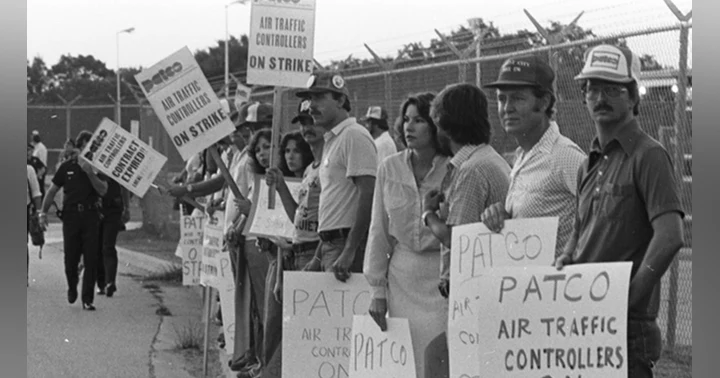
ATC: 45 Years After the PATCO Strike