Making the Brazilian ATR-72 Spin

Note: This story was corrected on August 10th at 10:23 am, thanks to the help of a sharp-eyed reader.
Making an ATR-72 Spin
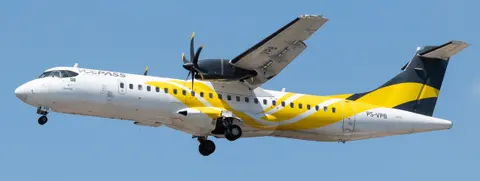
I wasn’t in Brazil on Friday afternoon, but I saw the post on Twitter or X (or whatever you call it) showing a Brazil ATR-72, Voepass Airlines flight 2283, rotating in a spin as it plunged to the ground near Sao Paulo from its 17,000-foot cruising altitude. All 61 people aboard perished in the ensuing crash and fire. A timeline from FlightRadar 24 indicates that the fall only lasted about a minute, so the aircraft was clearly out of control. Industry research shows Loss of Control in Flight (LOCI) continues to be responsible for more fatalities worldwide than any other kind of aircraft accident.
The big question is why the crew lost control of this airplane. The ADS-B data from FlightRadar 24 does offer a couple of possible clues. The ATR’s speed declined during the descent rather than increased, which means the aircraft’s wing was probably stalled. The ATR’s airfoil had exceeded its critical angle of attack and lacked sufficient lift to remain airborne. Add to this the rotation observed, and the only answer is a spin.
Can a Large Airplane Spin?
The simple answer is yes. If you induce rotation to almost any aircraft while the wing is stalled, it can spin, even an aircraft as large as the ATR-72. By the way, the largest of the ATR models, the 600, weighs nearly 51,000 pounds.
Of course, investigators will ask why the ATR’s wing was stalled. It could have been related to a failed engine or ice on the wings or tailplane.
The ATR has had several accidents related to ice over its 40-year history. The local Sao Paulo weather today indicated icing aloft was a definite possibility. If the ATR’s deicing system could not remove the ice the aircraft encountered at 17,000 feet, the wing or tail could have stalled. Worse yet would have been if the wing iced up and later shed only a portion of that icing load, perhaps on only one wing. A stall encountered under this condition could have initiated the rotation.
Then there is the possibility of an engine failure. Pilots who possess a multi-engine rating will remember the VMC demonstration during training. This maneuver demonstrates to the pilot applicant that things can go to Hell in a handbasket pretty quickly in a twin-engined airplane when one of those engines stops producing power. It’s natural for a twin to begin slowing following an engine failure. The remaining engine is then normally brought to 100 percent power. But as the aircraft slows, the flying pilot must add rudder pressure toward the operating engine to keep the aircraft under control. But … there’s only so slow that aircraft to fly with the good engine producing full power. Vmc, then, is the airspeed at which the aircraft – even with the rudder jammed to the floor – will no longer maintain wings-level flight. Without enough rudder, the airplane can begin to roll, unless the pilot pulls the power back on the good engine. Once the aircraft begins to roll, the flying pilot has only a few seconds to try and wrestle back control. And for those who watched the Vmc demo video thinking it didn’t look all that tough, remember this pilot knew what was coming. Voepass 2283’s crew would not have known what was ahead.
In most twins, because Vmc airspeed is not all that many knots greater than the aircraft’s stall speed, a spin is almost inevitable. Most twin-engine aircraft are NOT recoverable from a spin, no matter how the aircraft entered it.
The Crew
Investigators will also be looking closely at the two pilots responsible for flight 2283 on August 9, 2024 and anything that might point to a reason these two aviators lost control of their aircraft. What was this crew’s experience with the ATR-72 and how recent was that experience? What story might their initial and recurrent training records show. Also, what kind of duty day did these two pilot have? Was this their first trip of the day or perhaps their fourth or fifth leg. Were these two pilots familiar with each other or were they new and still learning the other’s habits. Did the weather forecast for this hour and a half flight turn out as expected, or might the pilots have encountered a surprise or two.
Any of these crew issues could have resulted in their not recognizing an impending stall and the loss of control that followed.
Again, I’ve outlined a few of the more obvious possibilities that this aircraft got away from the two pilots. There’s sure to be more to the story, so stay tuned.
Rob Mark, publisher
BTW – If you enjoyed this story and found it useful, please share it with a friend. And remember, a subscription to Jetwhine costs you nothing. Just add your e-mail in the box beneath this story.
PS – Thanks to my pal Max Trescott from Aviation News Talk for his help with this sad story.
ATC: 45 Years After the PATCO Strike