Aviation Safety & Unrealistic Expectations
Has the exemplary aviation safety record become its own worst enemy because it instills unrealistic expectations of risk in the minds of those fly? As a consequence, reactions to these infrequent but unpreventable circumstances instantly climbs to a level above and beyond hyperbole.
 We all know that complacency in pilots can lead to unfortunate outcomes. But what about passengers? Do the years that often separate fatal airline and business aviation accidents build a sense of risk complacency in their minds? Do they think “It can’t happen to me.”?
And what about passengers in general aviation airplanes flown for fun and/or personal business? Do they harbor delusions of risk-free flight? Do they consciously acknowledge the risk they assume when they fasten their seat belts, like those who must read the mandatory passenger warning in amateur-built experimental aircraft: This aircraft is amateur built and does not comply with the federal safety regulations for standard aircraft.
Some might say that a realistic understanding of the risks involved with flying would be bad for business. This might be true for the media, which reaps the financial rewards of higher ratings by force feeding questionable “news” to an audience that can’t turn away (or turn off) the spectacle. But if the automobile industry is any clue, a more realistic grasp on the risks involved wouldn’t hurt aviation.
Vehicular accidents are so common that to make the news they must be spectacular and involve large numbers and, this winter, large trucks. Most people, I think, understand and accept this risk, and adjust their plans and routes accordingly.
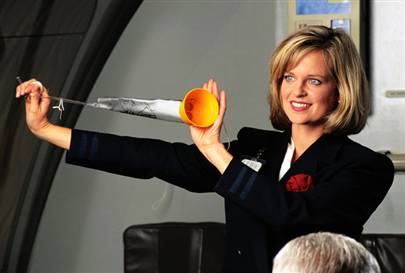
 Others might suggest that the safety briefing performed before takeoff by the cabin crew is the connection to the reality of aviation’s risks. Maybe. But how many passengers pay attention? It is not a participatory event like the abandon ship and life boat drills that starts the cruise on some floating city. Nothing makes the point of assumed risk more real than putting on a bulky life jacket, traversing a maze of passageways in quick, anxious steps, and wondering if your face wears the same nervous smile you see on the faces in your lifeboat line.
That brings me to our current aviation mystery, Malaysian Flight 370. It’s not the first airplane to go missing, as Amelia Earhart would surely agree, but the people of her day had a more realistic view of aviation’s inherent risks than we do today.
Technology has certainly played a role in this change, and that inspires my last question: Why aren’t commercial aircraft equipped with emergency position indicating radio beacons (EPRIBs)? Ships have them, and where they can disappear covers less area that an airplane’s final resting place. Airplanes operate in an environment that covers the entire globe, and then they fall to a surface that’s three-quarters wet. — Scott Spangler, Editor
ATC: 45 Years After the PATCO Strike