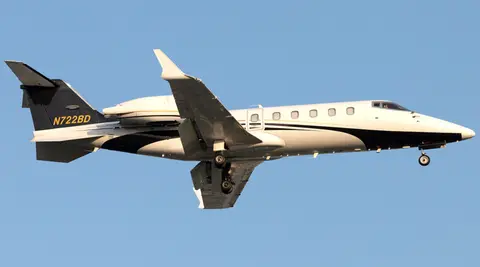
Center Controller Thinks About Crash of Learjet N722BD in Palm Beach
If you’ve spent any time with a pilot or an air traffic controller you probably realized we’re all Type A personalities. We’re goal oriented, not known for our patient and often in need of improved social skills. We all have trouble relaxing when there’s a job to do.
But a pilot or controller’s ability to analyze a problem and translate that into a quick decision is what makes pilots and air traffic controllers good at their jobs. Imagine a pilot who sees threatening weather ahead but can’t decide which way to turn. Or a controller watching two or three airplane’s courses converging but needs more time to decide what to do in order to prevent a collision.
None of us are perfect however, and sometimes we make bad decisions.
_____________________
It’s been a week since the horrific early afternoon crash of a Lear 60 – November 722 Bravo Delta – in Palm on November 1st, claiming the lives of all nine people aboard. The charter flight was enroute to scenic North Eleuthera in the Bahamas from Austin, Texas when its planned route brought it face to face with a line of severe thunderstorms. With tops near the 50,000-feet, the storms demanded serious re-route planning by the two pilots. For some reason, the pilots chose to remain pretty much on course, a flight plan that channeled them over West Palm and into some of the meanest cells. Foremost in the NTSB’s month’s long investigation will be asking why the pilots made this decision.
This wasn’t the first business-aviation accident this year, but it understandably captured the attention of nearly everyone on the face of the Earth with the freeze frame shot of the jet a fraction of a second before impact. Then there was the ATC audio. The NTSB, of course, would never publicly release the actual audio of an accident. The audio clips were recorded from a public source, LiveATC.net. and posted to the Internet.
If you haven’t already heard the brutal audio, just skip it. It highlights what bad dreams are made from.
What captured everyone’s attention of course was the interaction between the young woman pilot sitting in the right seat of the Lear and the Miami Center controller, agonizing second by second conversation that allowed anyone to create a picture in their head about the flight’s final moments.
What captured people’s attention was not simply the co-pilot’s explanation of the ice they’d run into a 35,000 feet or the moderate turbulence. As a solution, the pilots tried to climb higher to find a smoother ride and presumably less ice. A few moments later, the copilot’s frightened voice declared, “Mayday, Mayday. N2BD … descending 10,000 feet per minute.” Shortly after that, the copilot, almost breathlessly told ATC “We’re in an overspeed condition descending at 22,000 feet per minute” adding, “we’re going to crash into the ground.” In the final seconds, the jet now out of any human control, she screamed presumably to the other pilot, “Look outside. Look outside. Holy beep we’re out of time.” Then silence. An early report detailed that portions of the Lear’s elevators were found miles from the accident confirming it had left the airplane before the crash, most likely because the metal had been overstressed in the turbulence. A fraction of a second later, the Lear 60 augured into a city street creating a 10-foot diameter hole.
I sat in front of my computer with my mouth hanging open. Max and I regularly read accident reports in preparation for NTSB News Talk, but I’ve seldom heard the final words of a pilot anything like this. It was haunting and heartbreaking. The souls in the aircraft are now at rest, while the anguish of these deaths will haunt their loved ones for the rest of their days.
With the horrific nature of this accident, I doubt anyone has given the Miami Center controller working the Lear a second thought. Having spent 12 years of my career as an air traffic controller, some in a radar facility, I think I understand the feeling of helplessness that controller’s might have experienced.
Like pilots, controllers study manuals that explain precisely how they are expected to perform their job. The controller bible – known as FAA Order 7110.65 – lays out the required separations between aircraft and the precise phraseology they’re expected to use when interacting with pilots. Of course they can’t cover every situation a controller might face.
I’m not comparing what the Miami controller experienced before and after the accident to the loss of life aboard the aircraft, but controllers are also just people. This controller first heard the Lear pilot’s report of turbulence as well as their request for a glimpse of what they might face during the ride ahead. “Let me know if you need anything else and I’ll check on the rides ahead.” Pretty standard phraseology.
The controller’s radar would have shown some of the bad weather in the area. but not necessarily all of it. ATC radar focuses on airplanes, not weather. The controller offered the pilots some discretion in their heading to avoid what weather they could, but added, “not further right because of other conflicting traffic.”
When the copilot unexpectedly announced the airplane was descending at 10,000 feet per minute, the controller’s response was simple. “722 Bravo Delta, roger.” The controller’s eyes and brain would have focused directly on the Learjet’s target on his radar screen desperately trying to figure out what was happening to the airplane.
As he heard the woman’s terrified voice declaring the aircraft’s overspeed condition, he rather calmly replied, “722 Bravo Delta, roger. Altitude your discretion. Let me know what you need.” At this point, without keying his microphone, the controller was probably saying “Holy beep,” to himself while also trying to grab the attention of other nearby controllers for help. There wasn’t much any of them could do though.
Then the copilot said, “We’re going to crash into the ground,” to which he replied, “November 722 Bravo Delta, I’m here with you. Talk to me.” The controller wasn’t even sure of the questions at this point, much less the answers.
Now out of control, the other pilot can be heard praying while the controller replied, “November 2 Bravo Delta, roger.” The co-pilot, now frightened out of her wits but almost resigned to their fate said, “Holy fuck. We’re out of time.” The severity of the situation was clear to the controller who then called out, “November 2 Bravo Delta. November 2 Bravo Delta, how do you hear?” A few seconds later, “November 2 Bravo Delta, Miami.”
But it was all over.
My guess is that Miami controller was left sitting in front of his radar display with his mouth hanging open too trying to make some kind of sense of the previous 70 or 80 seconds. There’s nothing worse as a controller than watching an accident about to happen knowing there’s absolutely nothing you can do about it.
There’s an old saying that no controller ever died falling out of their chair. Anything the Miami controller felt or tried to do pales in comparison with the price paid by those aboard the Learjet.
I doubt few, if any, of the controllers heeding the FAA’s recent siren calls to hire on to the ATC ranks have ever experienced anything like this. I think the agency should make it mandatory to listen to the 80 seconds of the audio surrounding the N722BD crash. Some of them might change their mind about becoming a controller. Better they should decide early on.
Having been married to a shrink for 35 years, I know coping with trauma is not easy for many people. Sure the controller didn’t die in this accident, but he’ll have these final seconds of that flight and those people’s lives etched into his mind for the rest of his days.
So to that Miami controller … I have no idea who you are, but “peace be with you brother. I wish you many more years of keeping the South Florida skies safer. But if you find yourself struggling … please don’t be afraid to ask for help. Your loved ones deserve it.
___________________
I hope you enjoyed this episode of Stories about Flying. Please share it with a friend. Questions or comments can be directed to me at rob@storiesaboutflying.com. We’ll see you next time.
ATC: 45 Years After the PATCO Strike