Is Silence a Symptom of Aviation Atrophy?
 With no demands or duties, I retired to the deck on Father’s Day to reflect on my life’s journey, to appreciate the good times and bad that are its waypoints. A caressing breeze ebbed and flowed from the west like wind waves on the sky’s shoreline as I stared absently at an unseen stylus scribing a chalky white arc of vapor across a cloudless blueboard at 35,000 feet.
The songbirds uninterrupted medley almost drowned out the muted road noise, civilization’s inescapable tinnitus. It wasn’t until the Cessna 182, which resides on Omro’s eastern limit at Skydive Adventure, buzzed determinedly skyward that I realized that of all the places I’ve lived, this small town of 3,000 is infrequently below flying machines of all types.
Your perspective will assess this odd or not, but it seems incongruous because Omro is roughly 10 miles west of Oshkosh’s Wittman Regional Airport, home of the world’s busiest control tower, and during that one week of EAA AirVenture, the sky over Omro is, indeed, alive with airplanes. But over the intervening 51 weeks, it’s pretty quiet.
I wonder, is this silence a symptom of aviation atrophy, an industry contracting through lack of use, time, money, interest, or all of the above? Or is it a fluke of location?
I’m not sure what this means to aviation. Since I’ve been able to look up with understanding, airplanes and their sweet sounds have been a nearly uninterrupted soundtrack. This was true when I lived near airline hubs like Kansas City and San Francisco, but also in areas less populated. In the 1980s Mexico, Missouri, was home, GA craft were like robins in spring, and this was before Zenith Aircraft came to town.
Since I moved here, months before the new century started, rare is the week in which I hear and see more than a dozen airplanes. Fox Valley Tech’s trainers are common during the school year. An RJ screeches by maybe once a week. The EAA B-17 preps for its annual tour in spring, and on autumn weekends the Tri Motor leaf peeps. Maybe twice a year I’ll catch a Basler BT-67 on its maiden flight, and just before sunset on Elysian summer evenings a Challenger or Cub or open-cockpit Waco sometimes wanders over. I love helicopters, but I hate to see ThedaStar, because it means someone is seriously suffering.
In my youth, people flew for fun, and they did it often at my boyhood hangout, what is now the Schaumburg Airport. When I started my career and family in the 1980s, it seemed that justifiable business took precedence over fun. And now? When I hear a six-cylinder buzz I wait. Rarely does it continue uninterrupted. When it suddenly goes to idle the sentence of silence is punctuated by the rustling fabric snap of opening parachutes.
Or maybe the lack of quotidian aviation activities around Oshkosh is a condition specific to the Oshkosh area, nature’s way of balancing the aerial overload that wings this way every summer. But maybe not. Search your memories and compare what was with what is, and adjust for location. How would you measure the aviation activity where you’ve lived over your lifetime? — Scott
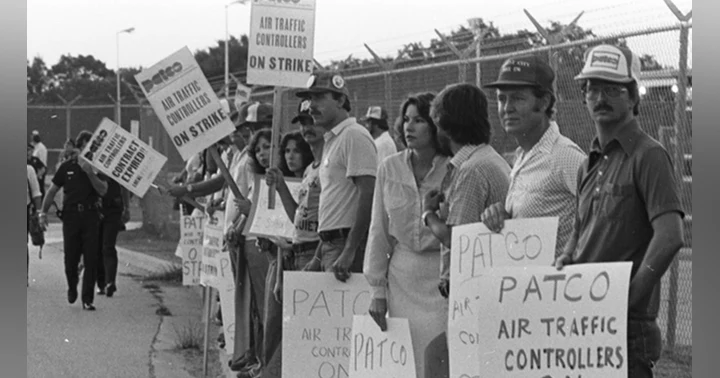
ATC: 45 Years After the PATCO Strike